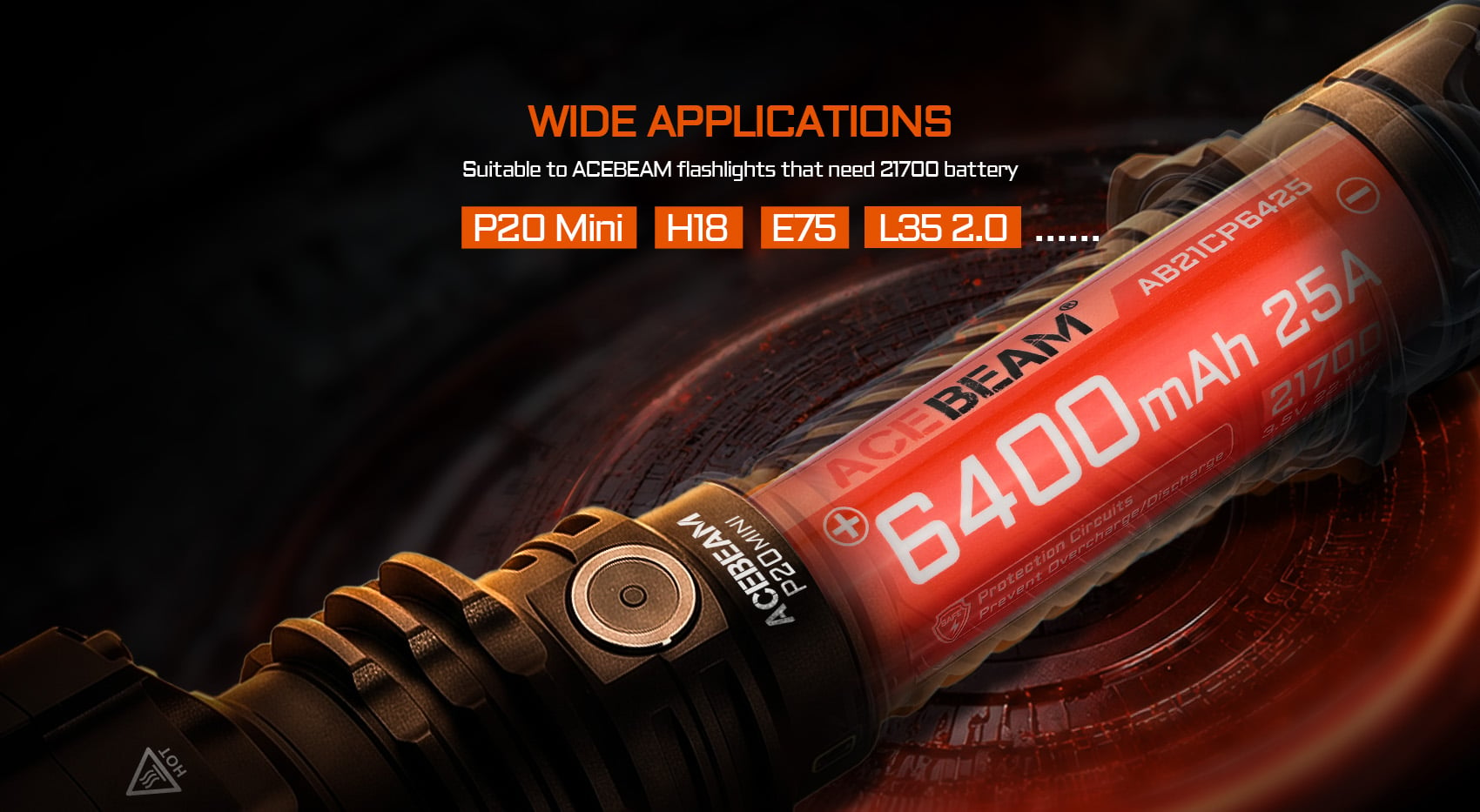
Many ACEBEAM users ask: how should you choose between a 21700 and an 18650 battery for your flashlight? It is more than a spec-sheet decision: it affects brightness, runtime, weight, and whether your light can even use the cell safely. In this guide, we compare 21700 vs 18650 across capacity, discharge, size, runtime, and flashlight compatibility, so you can choose the right battery.
Short answer: choose a 21700 for longer runtime and higher output; choose an 18650 for the most compact, lightweight EDC.
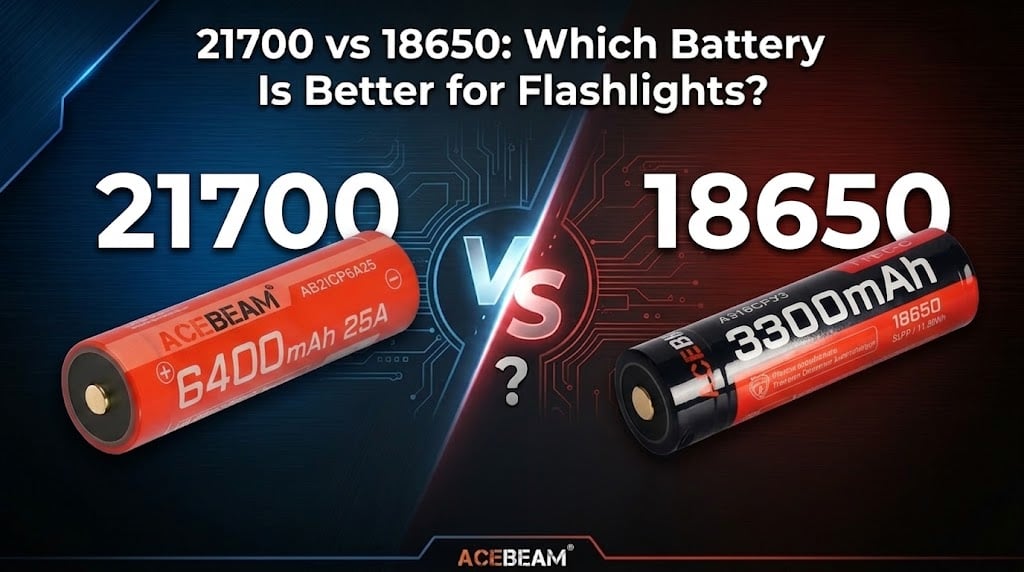
Quick Comparison: 21700 vs 18650
| Spec | 18650 | 21700 |
|---|---|---|
| Size (diameter x length) | 18mm x 65mm | 21mm x 70mm |
| Typical capacity | 2,500-3,500 mAh | 4,000-5,000 mAh |
| Highest available | ~3,500 mAh | 6,400 mAh (Acebeam) |
| Continuous discharge | up to ~15A | 25-30A |
| Cell weight | ~45-48g | ~68-70g |
| Volume | baseline | ~35% larger |
| Best for | compact EDC lights | high-output, tactical, long-runtime lights |
Five Dimensions Compared
1. Capacity
The most significant difference is energy storage. An 18650 battery typically maxes out around 3,500 mAh, while a 21700 battery delivers about 5,000 mAh as standard. That is a 30-50% capacity increase from the same chemistry.
The gap widens further at the high end. Acebeam recently launched a 21700 battery with 6,400 mAh and a built-in USB-C charging port. At 6,400 mAh, this represents one of the highest capacities available in the 21700 form factor, and it's exclusive to the brand.
2. Discharge Rate
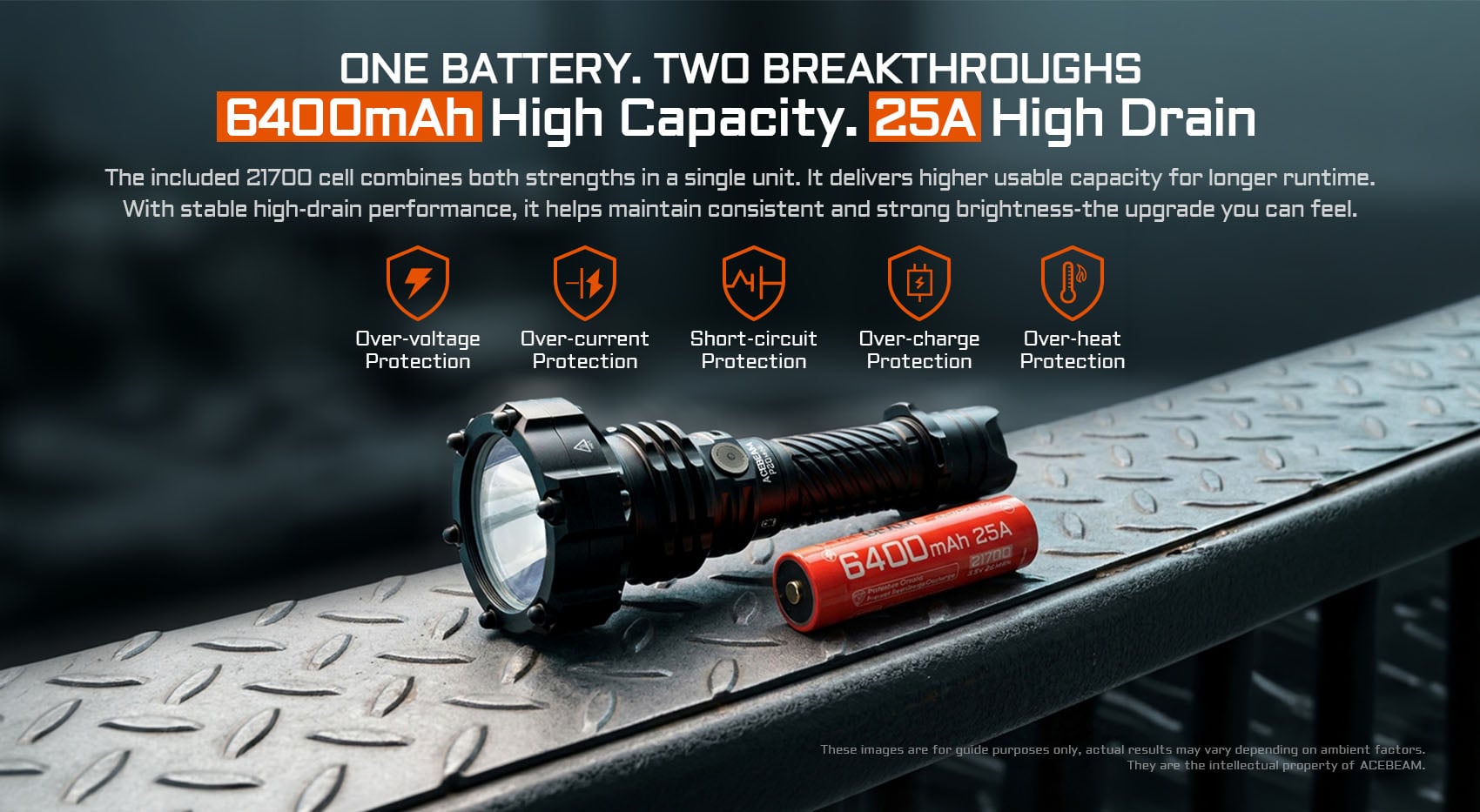
High-performance flashlights need batteries that can deliver sustained current without voltage sag. While 18650 cells can reach ~15A continuous discharge, 21700 cells routinely support higher outputs, up to 25A or 30A. The 6,400mAh Acebeam battery supports 25A continuous discharge, making it capable of powering 4,000-lumen tactical lights without breaking a sweat. Acebeam's tabless 21700 cells take this further, rated for up to 30A.
3. Runtime
More capacity means longer runtime, plain and simple. Moving from a well-matched 18650 battery to a comparable 21700 typically yields 20-40% longer runtime with the same driver efficiency.
4. Size & Weight
The naming tells the story: 18650 = 18mm x 65mm; 21700 = 21mm x 70mm (note that actual dimensions may vary slightly depending on the specific model). The 21700 is about 35% larger in volume and weighs roughly 20-30g more.
That extra size makes a 21700-powered flashlight noticeably larger in hand. Most are still pocketable, but they are not as discreet as an 18650 light. In the 18650 vs 21700 debate, this is where the decision is really made: for EDC carry where every millimeter and gram counts, the classic 18650 torch battery remains the winner.
5. Recommended Light Types
So which lights pair with which cell? Most flashlights that use 18650 batteries sit in the compact EDC class, while 21700 batteries power the high-output tier:
| Light type | Battery | Why |
|---|---|---|
| Compact EDC flashlight | 18650 | Smallest body, lightest carry, mature ecosystem |
| High-drain tactical light | 21700 | 25A+ sustained current for instant Turbo |
| High-lumen search light (3,000lm+) | 21700 | Capacity and discharge headroom |
| Backup and budget lights | 18650 | Lowest cost, widely available |
| USB-C rechargeable lights | 21700 (6,400mAh Acebeam) | Charge the cell directly, swap in spares |
Decision Guide: Which One Should You Choose?
Choose 18650 if:
- You want a compact, pocket-friendly flashlight for everyday carry
- You already own 18650 batteries and chargers
- Your flashlight is designed specifically for 18650 (they don't fit 21700 lights without an adapter)
- You prioritize lightweight and low profile over runtime
Choose 21700 if:
- You need maximum runtime for extended use without recharging
- You want higher peak brightness from high-lumen flashlights
- You're buying a new high-performance or tactical flashlight
- You don't mind the slightly larger size and weight
Staying with the smaller cell? The best 18650 battery for a flashlight is a high-drain model from a reputable brand, rated for at least 10A so Turbo mode stays stable.
How to Pick a 21700 Battery
Capacity: Where's the Ceiling?
Most 21700 batteries sit in the 4,000-5,000 mAh range. But the ceiling keeps rising. ACEBEAM 6,400mAh 25A 21700 batteries are now available, currently the highest capacity offered by any major flashlight brand in the 21700 form factor.
Discharge Rating: Match the Cell to Your Light
Check the continuous discharge rating against what your flashlight demands. A 3,000-lumen-class light draws serious current: pair it with a 25A cell, or Turbo will sag and step down early. For smaller EDC lights, a 10-15A rating is plenty.
Protected vs Unprotected
A protected cell carries a small circuit board that guards against overcharge, over-discharge and shorts, at the cost of a few millimeters of length. Unprotected cells rely on the flashlight's own driver for protection, which most modern lights handle well. The simplest route is a cell with protection built in, like the Acebeam 6,400mAh 21700.
Button-Top vs Flat-Top
21700 cells come with a raised button top or a flat top, and not every battery tube accepts both. If the cell doesn't make contact, the light won't turn on. Check your flashlight's specifications before ordering a spare.
USB-C Built-In Charging
Many modern 21700 batteries now include built-in USB-C charging ports. This means:
- No external charger needed, just plug in a USB-C cable
- Charge on the go from power banks, laptops, or wall adapters
- Status LEDs show charging progress (red charging, green full)
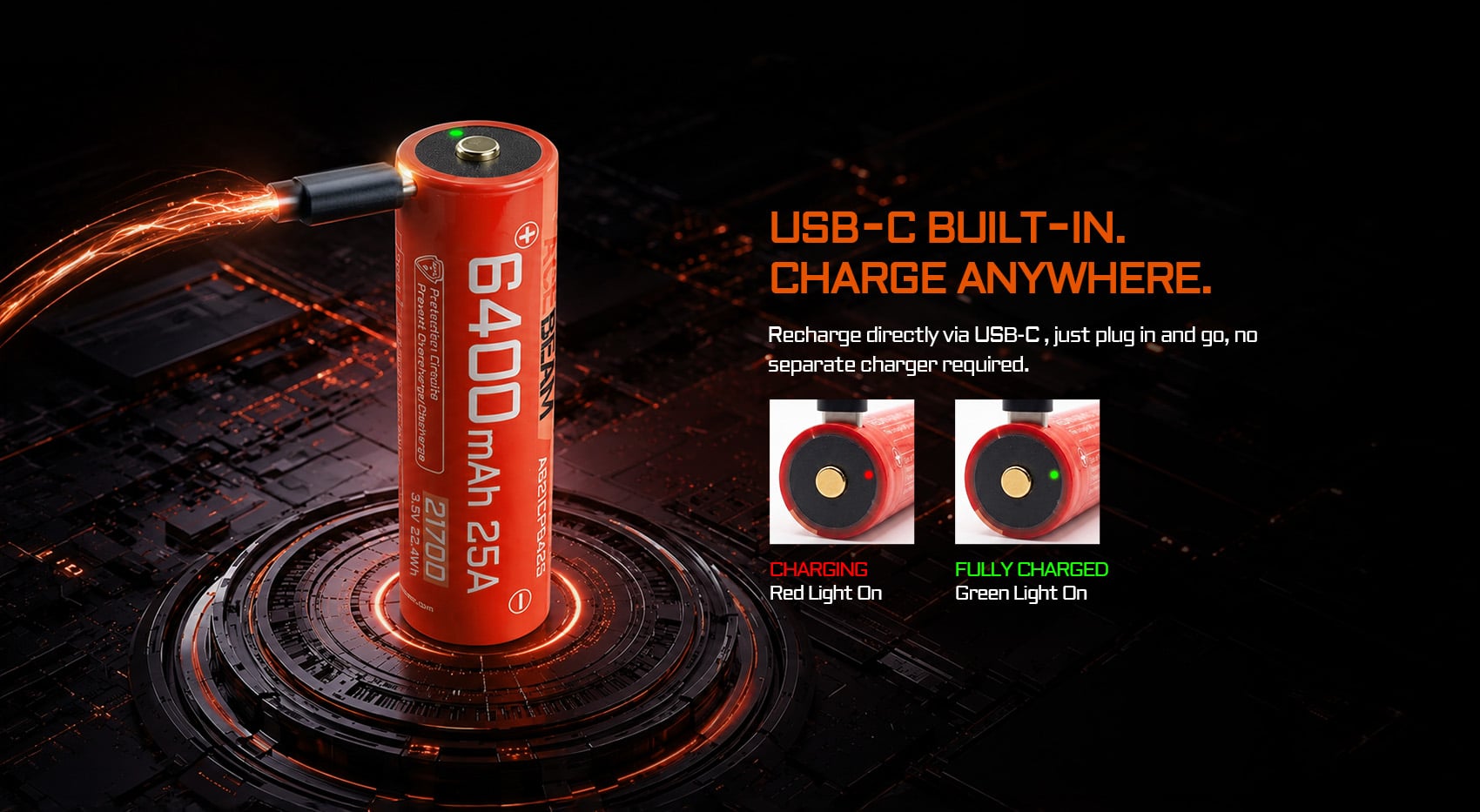
The Acebeam 6,400mAh battery, for example, includes an integrated USB-C port and sells for $24.90.
FAQ (People Also Ask)
Can I use an 18650 in a 21700 flashlight?
No, not directly. A 21700 flashlight is physically larger (21mm diameter vs 18mm), so an 18650 cell will rattle inside and may not make proper electrical contact. Some flashlights include spacer sleeves or adapters to fit 18650 cells, but this is not universal. Always check your flashlight's specifications.
Can I use a 21700 in an 18650 flashlight?
No, the 21700 is too large (21mm vs 18mm diameter) to fit into an 18650 battery tube.
Which battery lasts longer?
21700, by a significant margin. Typical 21700 capacity is 4,000-5,000 mAh versus 2,500-3,500 mAh for 18650. At the high end, 6,400mAh 21700 cells deliver more than double the capacity of many 18650 cells.
Is the extra size worth it for EDC?
That depends on your priorities. A 21700 flashlight is noticeably larger and heavier in the pocket. If you value compactness above all, stick with 18650. If you value runtime and output, the trade-off is worth it.
Are 21700 batteries more expensive?
Yes, but the price gap is narrowing. The Acebeam 6,400mAh 21700 retails for $24.90, while quality 18650 cells range from $10-20. Considering the 30-50% capacity increase, the cost per mAh is often better with 21700.
What's the difference between 18650 and 21700 names?
The numbers are physical dimensions in millimeters (see the full list of battery sizes):
- 18650 = 18mm diameter x 65mm length
- 21700 = 21mm diameter x 70mm length
The final "0" means cylindrical shape. (Note that actual dimensions may vary slightly depending on the specific model.)
Do I need a separate battery charger?
Not if your cell has built-in USB-C. The Acebeam 6,400mAh 21700 charges directly from any USB-C cable, so an 18650 battery charger or external cradle is only needed for standard cells without a port. Check before you buy.
Final Thoughts
So, which battery is better for your flashlight? If you prioritize compact size and broad compatibility, the 18650 battery remains a proven choice. But if you want longer runtime, higher output, and better overall performance, step up to the 6,400mAh 21700 battery, Acebeam's flagship cell with USB-C charging and exceptional capacity.